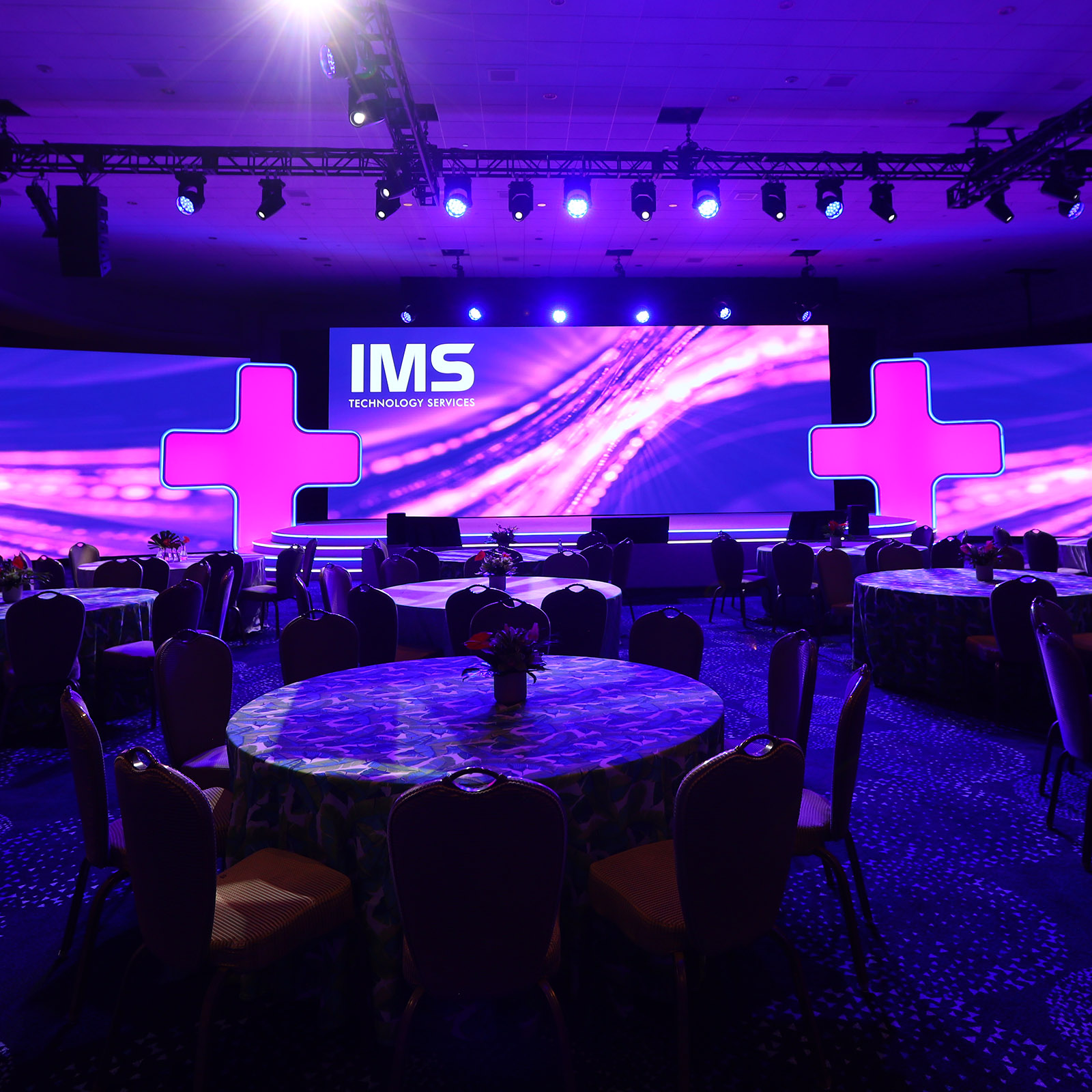
LED Wall vs. Projector for a General Session
The Real Decision Rule: Forget which one looks better. Ceiling height, ambient light, and budget decide whether your general session needs an LED wall or a projector, not image quality.
Somewhere in the second week of advance, someone on the client side asks if the screen can be “bigger, but also, like, not blow the budget.” You’ve heard some version of that sentence on every general session you’ve ever built. Behind it is a real decision, and it isn’t which technology is better. It’s which one survives the room you were actually handed.
Both LED walls and projectors can put an image forty feet wide in front of two thousand people. The room decides which one gets you there without a call to the client at 2 a.m.
What each one is actually for
Projection is glass and light thrown across a gap. LED is a wall built from tiles, each one lit from the inside. That difference in physics drives everything downstream: throw distance, ambient light tolerance, weight, rigging, and what happens when your general session runs an hour long because the CEO couldn’t stop talking about the roadmap.
A short-throw projector needs roughly 8 to 12 feet of clearance between lens and screen to fill a 10-foot-wide image, according to Treadway Events. Scale that up for a 24-foot ballroom screen and you’re either eating real floor space or hanging the projector from a truss position that may not exist in that room. LED needs none of that clearance. It mounts flush to a wall, a truss, or a freestanding frame, and the image starts exactly where the panel starts. If you’ve ever explained to a venue’s fire marshal why there’s a projection beam crossing a walking aisle, you already know which one wins on floor plan flexibility.
Brightness is the axis that actually kills more shows than pixel count ever will. LED panels run at a fixed, full brightness regardless of what the room does around them. Direct sun through an atrium skylight, house lights left up so people can take notes, a loading dock door propped open by catering, none of it matters to the panel. A projector needs a dark or dimmed room to read clearly, and it struggles badly in direct sunlight, per Treadway Events. Every ballroom you’ve ever advanced with south-facing windows was a projector’s worst day.
The numbers that actually move the decision
Pixel pitch is the spec people obsess over and the one that matters least once the room is right. The rule of thumb from MeyerPro: roughly 1 meter of minimum viewing distance per 1mm of pitch, or about 3.3 feet per millimeter. A 2.6mm panel looks clean from about 9 to 12 feet back and beyond, which is why MeyerPro calls it a strong baseline for a ballroom keynote where the front row isn’t pressed against the stage. Step up to 1.9mm (good from 6 to 8 feet) if you’ve got VIP seating inside that range or the content is being broadcast to camera, where softness reads instantly on a monitor. Don’t pay for a fine pitch on a wall the crowd views from 20 feet back. Nobody out there can see the difference, and you’ve doubled the panel cost for nothing.
Lumens follow the same logic in the other direction. A ballroom or general session running a 12- to 16-foot-wide image needs roughly 8,000 to 14,000 lumens to read clearly under typical ambient light, per MeyerPro’s projector guide. Push past a 16-foot screen and you’re into the 14,000-to-20,000 range, which usually means stacking or blending two units instead of running one box, and blending adds its own alignment fight during a load-in that already started two hours late.
Cost is where the two paths really split. Primal Sounds puts a same-day 16-by-10-foot LED wall rental, including delivery, setup, and strike, at $7,000 to $12,000, with a 20-by-12-foot-plus wall running $12,000 to $20,000 or more. Multi-day events add roughly 30 to 50 percent per additional day rather than a flat multiple, since the crew and truck don’t reset to zero overnight, and jobs in New York or LA run 30 to 50 percent above Mid-Atlantic pricing for the same gear. Treadway Events puts the overall premium simply: a well-specified LED setup runs two to four times what a comparable projector and screen cost for the same footprint. Projectors carry their own recurring cost nobody budgets for until it bites: bulb replacement runs $300 to $600 and is due every 1,500 to 3,000 hours of lamp life, per Treadway, while LED panels have no bulbs and replace bad tiles individually.
Two rooms, two right answers.
Take a 300-person regional user conference in a hotel ballroom with an 11-foot ceiling and zero rigging points, the kind of room where the house drape hides a wall that happens to be load-bearing. No truss, no fly points, a load-in window of four hours starting at 6 a.m. before the hotel’s own breakfast setup crew needs the space back. A 16-by-9 LED wall at that footprint runs into the thousands before you’ve even solved how it stands up without a rigging point to hang from. A projector and a fast-fold screen deliver the same 16-foot image, set up in under an hour, and don’t care that the ceiling won’t take weight. This is a projector room. It was always a projector room. The only real fight left is whether the client agrees to dim the house lights during the keynote, and for a content-heavy user conference where people are taking notes on laptops, that’s usually a fight worth having.
Now take a SaaS company’s annual kickoff for 600 people, in a ballroom with floor-to-ceiling windows down one wall, a brand backdrop that has to stay lit and legible through a Q&A with house lights at 70 percent, and a budget that already assumed LED because the sales deck showed one. This is the LED room. You’re not fighting the windows, you’re not dimming a room full of people who need to see their laptops during breakouts, and the wall pulls double duty as branded wallpaper during the cocktail hour before doors open. Budget $12,000 to $20,000-plus depending on final size, more if the show is in a top-tier market, and more again for every additional day on site.
LED wall vs. projector, side by side
| Factor | LED wall | Projector | | Ambient light | Full brightness regardless of room light or windows | Needs a dark or dimmed room to read clearly | | Rigging / floor space | Zero throw distance, mounts flush to truss or wall | Needs 8-12 ft of clear throw for a 10 ft image | | Typical single-day cost (16 ft wide) | $7,000-$12,000, delivery and strike included | A fraction of that for a comparable image on a fast-fold screen | | Up-close detail | 2.6mm reads clean from 9-12 ft; 1.9mm from 6-8 ft | Sharp at any distance once focused, limited by ambient light instead | | Recurring cost | None; swap a bad tile | Lamp replacement, $300-$600 every 1,500-3,000 hours | | Best fit | Bright rooms, branded backdrops, multi-use across a show | Low ceilings, no rigging, single-session budgets |
The actual decision rule
Stop asking which one looks better. Ask three questions, in this order.
Can the room take the weight and the rigging, and is there a wall or truss to flush-mount against? If the ceiling won’t hold points and there’s no floor space for a freestanding LED frame, you’re running a projector show whether the deck says LED or not.
Can you control the ambient light for the full run of show, including the parts that run long? If there’s a window wall you can’t drape, or the session bleeds into a reception with the house lights up, that’s an LED argument that overrides budget.
Does the premium buy you something beyond this one event? LED setups run two to four times what a comparable projector and screen cost for the same footprint. That premium is easy to defend when the wall becomes the branded centerpiece for cocktail hour, breakout signage, and next year’s kickoff deck. It’s much harder to defend for a single 90-minute keynote that gets struck by 6 p.m.
Run those three questions before you run the numbers on pixel pitch. Most rooms answer the question for you before you’ve opened a spec sheet.
What nobody tells the client
The thing that actually breaks a general session isn’t picking the wrong technology. It’s picking the right one and then under-speccing it to save four grand. A 2.6mm LED wall that’s properly rigged and blended beats a bargain 3.9mm wall on the same budget every time, and a properly blacked-out room with a mid-tier projector beats a premium unit losing a fight with a skylight. Spec for the room you actually have, not the room in the sales deck, and settle the fight over brightness before load-in, not during doors.